
We’ve all done it. We take out our phones and open a “ride-share” app (whether it’s Uber, Lyft, Circuit, or another transit provider) in hopes of getting from one place to another. But have you ever thought about what aspect of these transportation network companies (TNCs) actually involves sharing?

Ride-sharing and ride-hailing are often used interchangeably, but they actually aren’t the same…at all.
The Difference Between Ride-Hail and Ride-Share
Ride-hailing is the process of an individual hailing a ride. It can happen at the wave of a hand on a street corner or the tap of a finger on an app. Ride-hailing is only concerned with transporting one party at a time, in other words, there’s no real sharing going on here. Ride-hailing tends to give passengers a more luxurious experience but has high ride fares and increases traffic congestion, vehicle miles traveled (VMTs), and GHG emissions.Some people classify TNCs like Uber, Lyft, and traditional taxis as ride-shares, but without sharing, most of these trips are ride-hails.
Many of these ride-hailing companies have tried to introduce ride-sharing into their business models. For example, Uber created UberX Share (previously UberPool) and Lyft launched Lyft Line. However, some articles point to these shared services being a small fraction of overall rides.
Many TNCs interested in ride-sharing have yet to master the shared-ride. While UberX Share doesn’t publish data about its exact number of shared-rides, the online consensus suggests that the number is relatively low, and one driver shared that pooled rides made up less than 5% of his total ride volume unless he actively went looking for them. Lyft Line was permanently discontinued in 2023 because of disinterest from customers and drivers.
Ride-sharing involves sharing a ride with other passengers. Buses and trains are examples of traditional ride-shares because riders carpool in one vehicle to reach destinations in the same general direction. Ride-sharing can take your trip slightly out of the way, but it’s generally less expensive, more efficient in terms of congestion and overall wait times, works with existing public transit, and is better for the environment. Advances in technology have made efficient carpooling much easier.Circuit is an example of a ride-share company with many of our markets having over 70% of all rides being shared. Everything from our small service areas to our vehicle fleet has been chosen to specifically help us operate as a successful ride-share.
Let’s take a closer look…
Why (Algo)rhythm Matters: Vehicle Miles Traveled
%205.15.18%20PM%202.jpeg?width=1080&height=689&name=Algorithm%20Blog%20Graphic(1)%205.15.18%20PM%202.jpeg)
Imagine two passengers use ride-hail to get to their destinations. The driver drives one mile to pick-up its first passenger, one mile to drop them off, one mile to meet the next passenger, and one more mile to drop off the second passenger. This vehicle has delivered two passengers (pax) in four vehicle miles traveled (VMTs).
%205.15.18%20PM.jpeg?width=1080&height=661&name=Algorithm%20Blog%20Graphic(1)%205.15.18%20PM.jpeg)
Now, let’s look at ride-hailing. If these same two passengers choose ride-share, the driver will drive one mile to pick-up its first passenger, three quarters of a mile to pick-up its second passenger along the way, one mile to the first destination, and an additional quarter mile to the second destination. This vehicle has transported two passengers (pax) in just three vehicle miles traveled (VMTs). That’s a 25% reduction in VMTs, or traffic, in just one trip.
These miles all add up over time. Pooling algorithms help to get the most passengers to their destinations most efficiently, prioritizing the movement of many passengers over one passenger. Individual passenger wait times may increase, but overall wait times will decrease as will traffic congestion and GHG emissions.
So What About Pooling?
Ride-share should mean the same thing as pooling, though it’s often not used that way. At Circuit, we combine the algorithmic, demand-responsiveness of ride-hailing with the pooling element of ride-sharing to create an innovative and effective form of transit. Not every single Circuit ride is pooled because there are times when that’s a less efficient model, but generally, we’ve planned and executed our programs as ride-sharing services.
Conversely, some ride-hailing TNCs see ride-sharing as a business opportunity. Treating ride-sharing as an afterthought and not as a deciding factor when designing programs is part of the reason why these services tend not to see strong adoption.
Passengers feel cramped, inconvenienced, and unsatisfied with these pooling services. However, many of the issues riders have with these ride-shares don’t really have to do with the act of ride-sharing at all, but rather how ride-hailing companies that aren’t set up for pooling market themselves as ride-share providers.
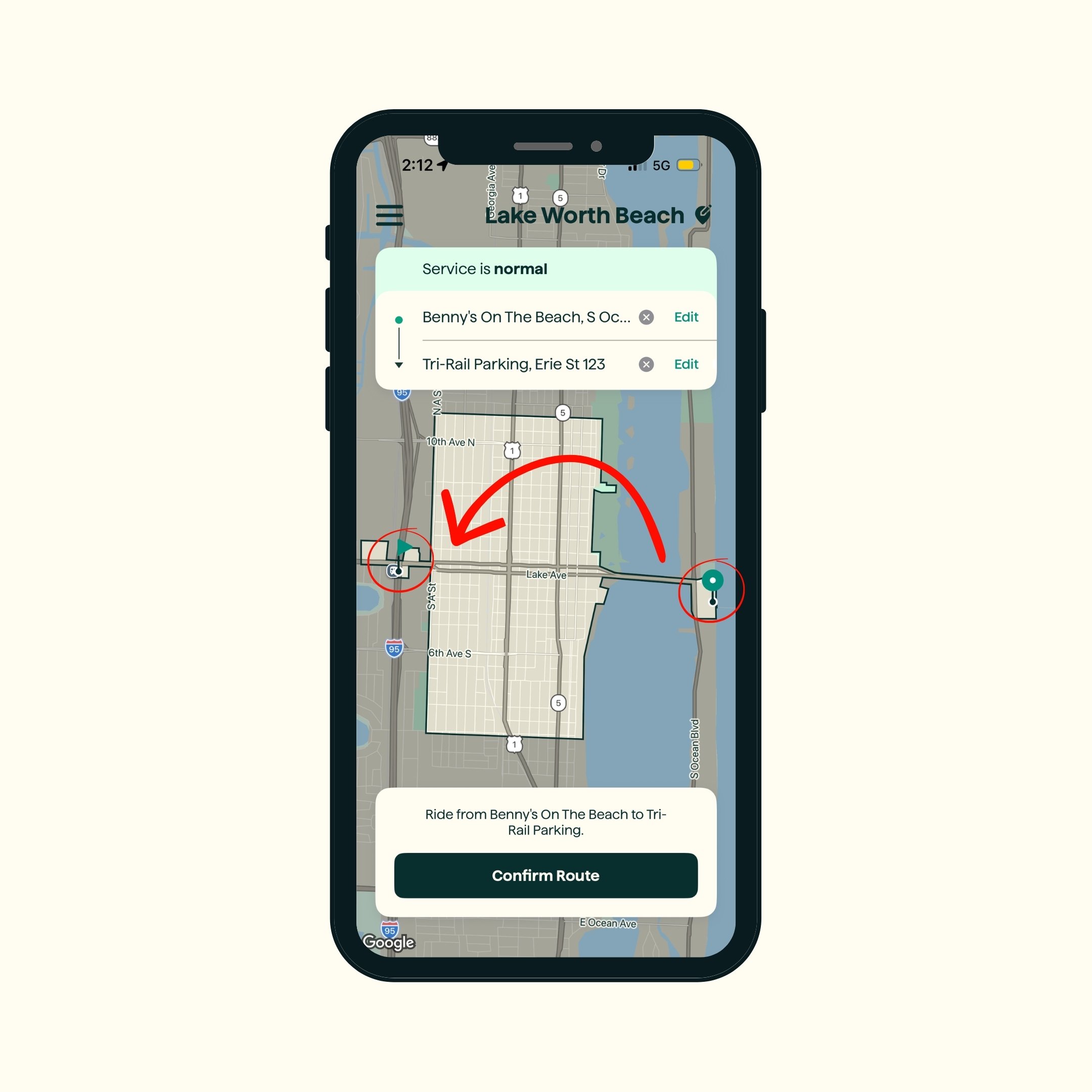
Many TNCs received backlash over pooling taking passengers far out of the way of their destinations to pick up another rider. At Circuit, some of our programs solve specifically for first- and last-mile gaps (see image above depicting how our service in Lake Worth Beach connects to the local Tri-Rail station) meaning our service areas are only a few miles big to begin with. Your ride can’t take you very far out of the way from your drop-off when your entire service area is only 2 miles wide.
Riders also don’t appreciate feeling crowded when getting into a car with other passengers that they don’t know. We take this into account when choosing our vehicle fleets to ensure that we operate vehicles where riders have their own doors and rows when possible.
At Circuit, maximizing transportation is our focus, and pooling is our special ingredient. It requires expert planning, specific vehicle types, and routing powered by our technology. Our pooling process is what allows us to serve our customers and riders with our prized dish: ever-improving, accessible, efficient microtransit.
As a ride-share and ride-hail company since the beginning, we’ve been evolving our algorithm since launching the first version of our app in 2016, and in that time, we’ve learned exactly what to prioritize to operate most efficiently.
The proof is in the pudding. We have an exceptionally high percent of pooled rides compared to other TNCs which means we’re able to maximize the efficient mobility of the most riders, even when compared to competitors who market themselves as notably more tech-centric. In addition, we maintain high rates of rider and driver satisfaction across our services proving that for pooling algorithms, quality reigns supreme and that there’s always elegance in simplicity.
The "We" in Wheels
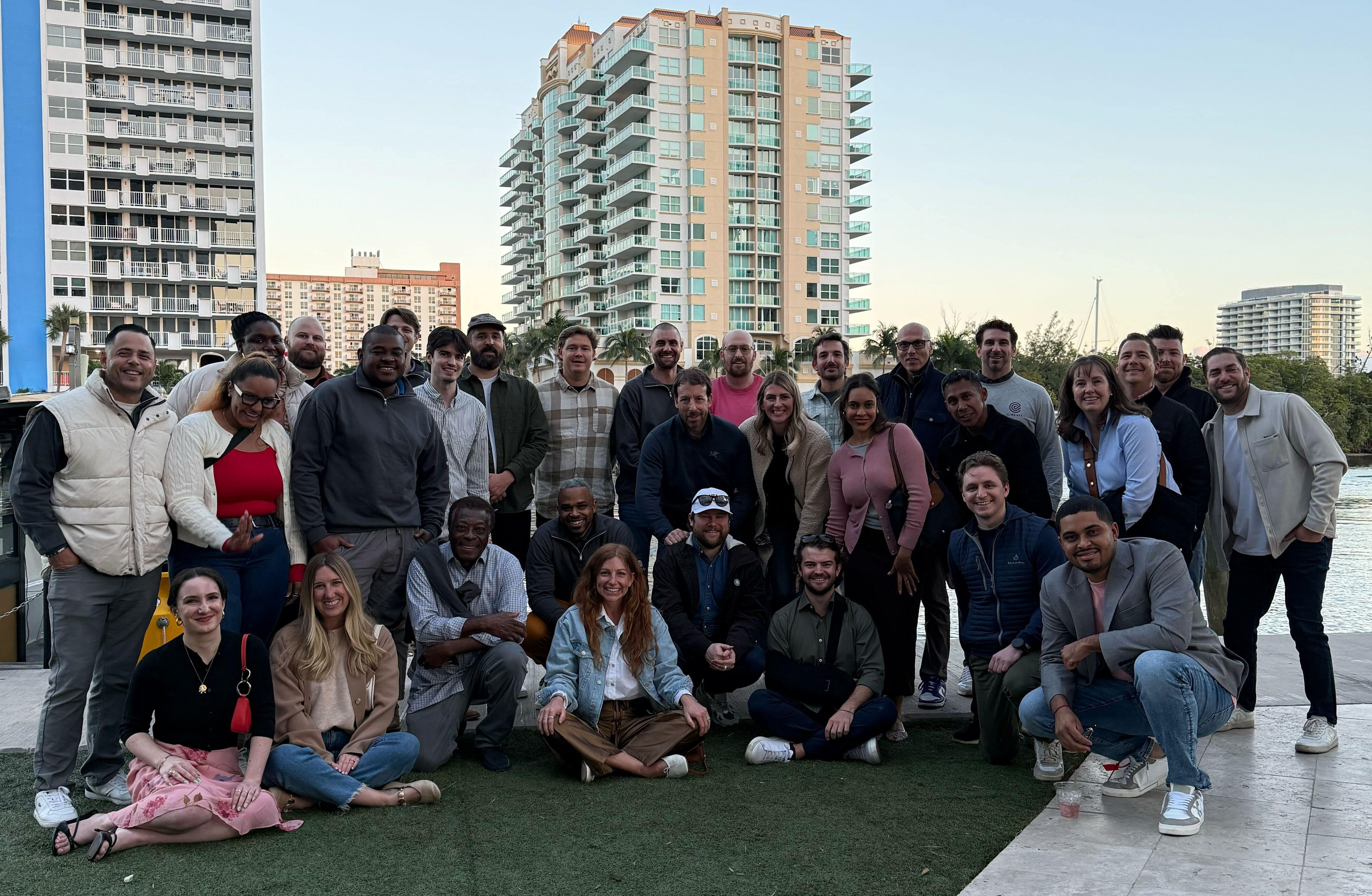
At Circuit, we pride ourselves in being a fully managed microtransit service. That’s why our operations team is an especially important element of our ride-share services.
Using the data from our tech and algorithms, our operations team provides white glove service, diligently overseeing the zones and routing policies of our locations to ensure every partner is getting the best service for their specific needs. Our ops team and the work they do allow us to regularly update our customers on the improvement of our service with them, and in turn provide customers with a clear point of contact should they need to reach us.
Our finely aged yet evolving algorithm has stood the test of time, and our dedicated operations team has used and interpreted it to make us who we are: a national brand with local expertise.
Want a Slice of the Pie?
Interested in launching a service, expanding your current zone, or adding seasonal amenities? Contact us, and we’ll be in touch!
.png)