
Electric microtransit can integrate with existing public transit by improving first- and last-mile connections, filling service gaps, connecting riders to major transit hubs, extending the usefulness of existing routes, and using ridership data to strengthen service over time.
For cities and transit agencies, the goal should not be to create another disconnected transportation option. Microtransit works best when it makes the public transit network already in place easier to access and more useful.
Here are five ways cities are already doing it with Circuit.
1. Solve the first- and last-mile gap
A bus or train may cover most of a rider’s trip, but getting to or from the station can still be the hardest part.
Microtransit can bridge that gap by connecting neighborhoods, housing, businesses, and other local destinations directly to major transit stops.
Circuit example: New Rochelle, New York
 Circuit has operated in New Rochelle since 2019, where the all-electric service connects riders throughout downtown with the New Rochelle train station and the Bee-Line bus system. The program now carries more than 5,000 passengers per month, and 90% of riders are New Rochelle residents.
That makes Circuit more than another local transportation option. It helps riders reach regional transportation and continue trips beyond the service zone.
2. Fill gaps in existing fixed-route service
Fixed-route transit is essential for moving large numbers of riders along major corridors, but it cannot efficiently serve every neighborhood or destination.
Microtransit can operate in the spaces between those routes.
Circuit example: Fort Lauderdale, Florida
 Fort Lauderdale launched LauderGO! Micro Mover to help bridge gaps in Broward County Transit service. Circuit provides free, all-electric transportation while directly connecting riders with Brightline, Tri-Rail, and the LauderGO! Community Shuttle.
The result is a more connected transportation network where riders can use microtransit for the shorter portion of a trip and higher-capacity transit for the longer one.
By December 2025, the program had surpassed 700,000 passengers.
3. Make major transit hubs easier to reach
Building a rail station does not automatically make it convenient for everyone to use.
Microtransit can expand the practical reach of those stations by giving riders a flexible connection from nearby homes, workplaces, hotels, and commercial areas.
Circuit example: Bellevue, Washington
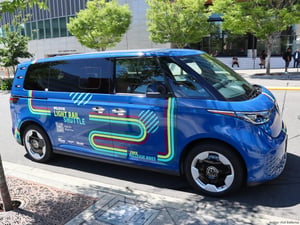 BellHop launched in Bellevue in 2023 as an all-electric, on-demand service. After strong early ridership, the City of Bellevue and Amazon helped expand the program to connect directly with the downtown light rail station.
BellHop carried more than 90,000 riders in its first year and surpassed 200,000 passengers by late 2025.
It is a strong example of how an existing microtransit program can evolve alongside new transit infrastructure.
4. Extend the reach of the larger transit network
Microtransit does not always need to be fully on-demand.
Cities can also use electric shuttles to create reliable feeder connections between major transportation systems and areas that sit outside their immediate reach.
Circuit example: Watertown, Massachusetts
.jpg?width=300&height=225&name=WATC%20Faire%202026-09-19%20(9).jpg) The WATConnector connects Watertown directly with Harvard Square through two weekday shuttle routes.
The WATConnector connects Watertown directly with Harvard Square through two weekday shuttle routes.
From Harvard Square, riders can transfer to the MBTA Red Line and local bus service, creating a direct connection between Watertown neighborhoods, employment centers, and the wider Boston transit network.
The service combines scheduled connections with smaller electric vehicles, showing how microtransit can be adapted around the transportation infrastructure a community already has.
5. Use real-world ridership data to grow the right connections
Public transportation needs change.
A strong microtransit program should give cities the data to understand where riders are going, which connections matter most, and where service should expand.
Circuit example: Long Beach, California
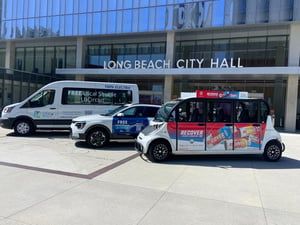 Circuit’s Long Beach service started as a small pilot and has expanded based on community demand.
Today, the program serves a five-square-mile area connecting Downtown Long Beach and Belmont Shore and provides more than 8,000 passenger trips per month. The service connects riders with destinations including local businesses, medical facilities, senior housing, and transit hubs.
Circuit has also become an important last-mile connection for commuters using the LA Metro station in Downtown Long Beach.
As ridership has grown, the city has expanded the fleet, added ADA-accessible vehicles, and increased the service area, demonstrating how microtransit can scale alongside demand rather than remaining a static pilot.
What does successful public transit integration look like?
The strongest microtransit programs do not operate alongside public transit. They become part of it.
That can mean:
⚡Bringing riders directly to rail stations⚡Filling areas between fixed bus routes
⚡Extending the reach of major transit hubs
⚡Creating feeder routes to regional transportation
⚡Using trip data to identify where connections should improve next
Circuit combines electric vehicles, routing technology, local operations, W-2 drivers, service planning, ADA-accessible options, and transparent reporting in one turnkey microtransit model.
For cities, that means adding flexible transportation without creating another disconnected system to manage.
Planning a microtransit program? Talk to Circuit about a fully managed service built around your community.
Frequently asked microtransit questions
💡 How does microtransit integrate with public transit?
Microtransit can connect riders with bus and rail stations, fill gaps between fixed routes, extend transit access into surrounding neighborhoods, and provide first- and last-mile transportation.
💡 What is first- and last-mile microtransit?
First- and last-mile microtransit helps riders travel between their starting point or final destination and a larger transit service such as a bus, commuter rail, subway, or light rail station.
💡 Can microtransit work with rail systems?
Yes. Circuit programs currently provide connections with systems including Metro-North, Bee-Line, Brightline, Tri-Rail, LA Metro, Sound Transit light rail, and the MBTA.
Learn More About Circuit and Our Service Impact
• Circuit Champions: The People Moving Cities: Yvette Drucker
• Pregnant in Trenton? This electric shuttle service is offering free rides
• Driving Independence: Senior Mobility in Chula Vista
• Reconnecting the Rockaways: Affordable Mobility for an Underserved Community
.png)