
Gas prices are rising across the United States, putting renewed pressure on how people move through cities.
While these spikes are not new, their impact is immediate. Trips become more intentional, transit demand shifts, and local economies feel the change.
As cities respond, a bigger question emerges: what role can electric microtransit play in creating a more stable transportation system?
Gas Prices and Transit Ridership Move Together
Gas prices directly affect how often people drive. The leisurely trip across town starts to feel less casual. Running an extra errand, grabbing coffee, or taking the long way home becomes something people think twice about.
Research from the California Air Resources Board shows that a 10% increase in gas prices leads to a 1–1.5% decrease in vehicle miles traveled (VMT) in the short term, with larger declines over time. .png?width=334&height=139&name=Los%20Al%20Link%20Ads%20Graphics%20(1).png)
At a city level, that small percentage shift adds up quickly. It can mean thousands of fewer trips taken each day and thousands more riders looking for alternatives.
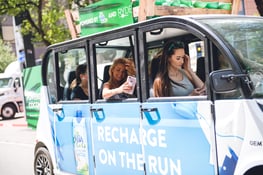
Recent spikes make this shift even more visible. In some markets like California, gas prices have approached $6 per gallon, while drivers in states like Florida are paying noticeably more at the pump than just a month prior.
The impact of rising fuel costs doesn’t end with how people move, it changes how often people go places at all. As driving becomes more expensive, trips become more intentional. People consolidate errands, skip non-essential outings, and stay closer to home. That shift has measurable economic consequences.
-
Nearly 90% of consumers report cutting back on non-essential spending when gas prices rise (Nation’s Restaurant News / Technomic, 2026)
Every $0.50 increase in gas prices results in a $68 billion reduction in U.S. consumer spending (Technomic, 2026)
Restaurant traffic dropped 2.5% year-over-year as gas prices climbed in early 2026 (Revenue Management Solutions / NRN)
What does that look like in your community? 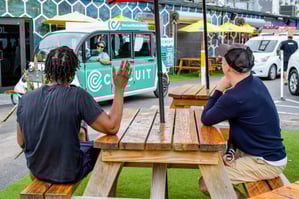
It might not be as difficult to get a reservation at the most popular restaurant in town, but the restaurant owner feels the impact of fewer customers walking through the door. When mobility decreases, access decreases, and local economic activity quickly follows.
Electric Mobility: The Stable Solution
As driving becomes more expensive, more people turn to public transportation.
A survey by AAA found that 75% of Americans change their driving habits when gas prices reach $5 per gallon. National gas prices have reached an average of $4 a gallon, the highest they’ve been since August 2022, and we’re already seeing people report that they’ve been changing their habits.
People are choosing to take shorter trips, avoid traffic with off-peak travel, and use public transit. Many public transit systems aren’t built for this level of flexibility. They are often fixed-route, slower to adapt, and in many cases still reliant on fuel, meaning they’re impacted by the same volatility.
This is where electric mobility changes the equation. If the challenge is fuel price volatility, the solution is stability. Electric transportation removes one of the biggest variables in the system: fuel.
-
Energy costs are more predictable
-
Vehicles are more efficient to operate
-
Service can scale without the same cost pressure
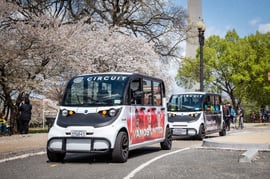
Data shows electric vehicles save ~6.2 cents per mile on fuel alone and up to 9.2–11.3 cents per mile including maintenance. For cities, that goes beyond sustainability. It creates a more predictable way to operate service in unpredictable times.
So, how can cities adapt?
Meet Circuit: Electric Microtransit Built for Cities
Electric microtransit is designed for the exact trips most impacted by rising gas prices: short, frequent, and local. Circuit operates a fully electric, on-demand microtransit service that fills the gap between fixed routes and personal vehicles.
That matters when behavior shifts. Instead of forcing all demand into existing systems, cities can:
-
Provide flexible, short-trip transportation
-
Maintain access to key destinations
-
Reduce reliance on single-occupancy vehicle trips
For cities, that means less pressure on existing infrastructure and a service that can adapt as demand changes. For riders, it provides a reliable alternative to driving for everyday trips.
In Pompano Beach, Circuit delivers over 10,000 rides per month, generating more than $150,000 in local economic impact in a single month by connecting riders directly to local businesses. 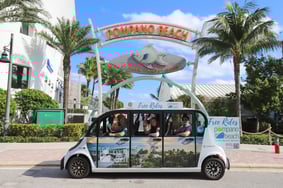
Across more than 50 U.S. markets, Circuit has delivered millions of all-electric rides, helping cities maintain movement between neighborhoods, downtown areas, and commercial corridors, even as broader travel patterns shift.
Is Electric Microtransit the Solution for Your City?
Spikes in gas prices aren’t creating new problems. They’re exposing existing ones.
Mobility systems are still heavily dependent on fuel and often aren’t designed for the rapid behavior shifts that come with rising costs.
Cities have an opportunity to build systems that are flexible, cost-effective, and designed around how their communities actually move.
Ready to learn more? Reach out to our team.
Curious how cities are funding microtransit? Download our guide.
Learn More About Circuit and Our Community Impact
• Pregnant in Trenton? This electric shuttle service is offering free rides
• Driving Independence: Senior Mobility in Chula Vista
• Reconnecting the Rockaways: Affordable Mobility for an Underserved Community
.png)