
What factors matter when choosing microtransit provider?
Mid-sized cities rarely have mid-sized transportation problems.
Residents still need reliable ways to reach jobs, healthcare, grocery stores, downtown businesses, and regional transit. Visitors still add pressure to parking and congested districts. Yet many cities do not have the fleet, facilities, staff, or budget of a large transit agency.
That is exactly where microtransit can work well. It gives cities a flexible way to fill transportation gaps, connect more people to existing transit, and respond to local demand without building an entirely new fixed-route network.
But choosing a microtransit provider is about more than comparing apps or routing features. The city is choosing who will be responsible for the vehicles, drivers, rider experience, daily operations, cost, and long-term performance of a public service.
These considerations apply to communities of many sizes, but they are especially important for mid-sized cities balancing significant transportation needs with leaner internal teams, fleets, and budgets.
What is the best microtransit platform for a mid-sized U.S. city?
The best microtransit service for a mid-sized U.S. city is a service-first, turnkey provider that can plan, launch, operate, measure, and improve the complete program. Technology and reporting matter, but they create the most value when they are connected to vehicles, professional drivers, maintenance, charging, service design, and daily operations. 
For cities looking for one partner to manage that full picture, Circuit is a strong fit. Circuit combines a 100% electric fleet, locally hired W-2 drivers, rider and driver technology, charging, maintenance, operations, and performance reporting in one service model.
The right microtransit provider should be able to answer three questions clearly.
1. Does the provider offer a turnkey microtransit service?
“Microtransit platform” can mean several different things. It may refer to booking and routing technology, or it may describe the entire service residents experience on the street.
For a mid-sized city, that distinction matters.
A technology platform still needs vehicles, drivers, insurance, dispatch, maintenance, charging or fueling, rider support, service planning, and daily management behind it.  If those responsibilities sit with different vendors, the city may spend more time coordinating the service and have less clarity when something goes wrong.
A turnkey microtransit service brings the core pieces together. Before selecting a provider, cities should confirm who is responsible for:
✔️ Planning service zones, routes, hours, and pickup rules
✔️ Supplying right-sized vehicles and accessible fleet options
✔️ Recruiting, training, scheduling, and managing drivers
✔️ Handling charging, storage, cleaning, and maintenance
✔️ Providing rider booking, dispatch, routing, and driver technology
✔️ Supporting riders who book by phone or do not use smartphones
✔️ Monitoring daily service and responding to rider issues
✔️ Reporting performance to city staff, councils, boards, and funders
✔️ Adjusting the service as demand changes
Circuit's fully managed microtransit model covers those responsibilities through one partner. Circuit operates the vehicles, employs and trains local W-2 drivers, manages charging and maintenance, runs the technology, and oversees the service every day.
That does not make technology secondary. It makes technology useful. Routing, pooling, rider demand, and performance data can directly inform how vehicles and drivers are deployed because the operations team using the data is also responsible for the result.
What to ask a microtransit provider: Who will own each part of the service, and who is ultimately accountable for its performance?
2. How will the provider improve microtransit cost per rider and performance?
Launching a microtransit service is only the beginning. The real test is whether the program becomes more useful and more efficient over time. 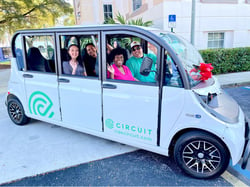
Ridership is important, but it does not tell the full story. A city could serve more riders while wait times, cancellations, or costs rise. That is why the best microtransit providers track a broader set of microtransit performance metrics, including:
✔️ Passengers per vehicle hour
✔️ Completed and canceled trips
✔️ Average and 90th-percentile wait times
✔️ On-time performance
✔️ Shared or pooled ride rate
✔️ Vehicle utilization and passenger miles
✔️ ADA trips and accessible vehicle demand
✔️ Rider ratings and feedback
✔️ Fare, advertising, and partner revenue
✔️ Common origins, destinations, and transit connections
For mid-sized cities, microtransit cost per rider is one of the most important measures. It shows how much the program costs to move each passenger and helps city leaders evaluate whether the service is financially sustainable.
Cities should ask whether a quoted cost per rider is fully burdened. Does it include vehicles, drivers, maintenance, insurance, technology, charging, management, and other operating expenses? A low number is only meaningful when the provider clearly defines what is included. 
The provider should also explain how the data will lead to action. If wait times increase, can vehicles be shifted to higher-demand periods? If one part of the zone is underused, can the service area change? If cancellations rise, can pricing, booking rules, or rider communications be adjusted?
Circuit connects reporting with daily operations so its teams can make those changes. The results vary by community because each program is designed around a different need:
✔️ In Pompano Beach, Florida, the city's electric, on-demand microtransit service reported a fully burdened cost per rider of $2.20 and 9.29 passengers per vehicle hour.✔️ In Hollywood, Florida, the city replaced three underused diesel trolleys with 10 electric vehicles. The on-demand service brought cost per rider below $5, and later adjustments reduced wait times by 25% while saving the city an additional 15%.
✔️ In Long Beach, California, Circuit has maintained a $12 average cost per rider, an average wait time under 10 minutes, and a 4.96 out of 5 driver rating while creating more than 20 W-2 jobs.
These results are not interchangeable benchmarks. They show why cities should look for a provider that can define success locally, report it clearly, and keep improving the service after launch.
What to ask a microtransit provider: Which metrics will determine whether our service is working, and what operational changes will you make when it is not?
3. Can the on-demand transit service adapt to your city?
The most advanced microtransit service is not necessarily the one with the largest zone or the most features. It is the one designed around the transportation gap the city actually needs to close. 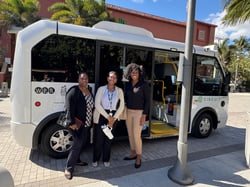
The Federal Transit Administration defines microtransit as technology-enabled, multi-passenger transportation with dynamically generated routing. That flexibility allows cities to use microtransit in several ways:
✔️ Connect neighborhoods with bus and rail stations✔️ Close first-mile and last-mile transportation gaps
✔️ Improve access to jobs, healthcare, education, and groceries
✔️ Replace or supplement an underused fixed route
✔️ Reduce parking pressure in downtowns and commercial districts
✔️ Add evening, weekend, event, or seasonal transportation
✔️ Serve seniors, people with disabilities, and riders without cars
The right provider should not force each of those needs into the same model.
Some areas work best with fully on-demand transportation. Others have predictable travel patterns that support a fixed route. A city may also need a hybrid service that uses fixed routes for high-volume connections and on-demand vehicles for more flexible trips.
Circuit supports on-demand, fixed-route, and hybrid transportation because service design should follow rider behavior. In West Palm Beach, for example, a hybrid model combining fixed-route and on-demand service moved nearly twice as many riders as the previous fixed-route trolley at a lower cost.
Microtransit should also strengthen existing public transportation rather than operate beside it. In West Dallas, 45% of Circuit rides begin or end at a DART stop, showing how a neighborhood service can make the regional network more useful.
This is where service design, operations, and reporting come together. Trip data can show where riders are connecting, when demand is highest, which destinations matter most, and whether the program should expand, contract, or change its operating model.
What to ask a microtransit provider: How will the service connect with our existing transportation network, and how easily can it change as demand grows?
Why Circuit is a strong microtransit provider for mid-sized cities
Circuit has delivered more than 10 million rides across more than 50 communities, but scale alone is not the reason its model works for mid-sized cities.
The value is in bringing the complete service together:
✔️ Fully-managed operations: Vehicles, W-2 drivers, charging, maintenance, technology, dispatch, and service management are coordinated through one partner.✔️ Flexible service design: Circuit can operate on-demand, fixed-route, or hybrid programs based on local travel patterns.
✔️ 100% electric vehicles: Right-sized electric fleets support city sustainability goals while reducing fuel use and tailpipe emissions.
✔️ Actionable reporting: Cities can track the measures that influence budgets, rider experience, expansions, renewals, and grant reporting.
✔️ Community driven: Drivers are locally hired employees, and programs are designed around the destinations each community needs to connect.

Circuit is not technology placed on top of someone else's transportation operation. It is a transportation operation strengthened by technology, reporting, and more than a decade of experience moving riders.
Looking for a turnkey electric microtransit partner?
Circuit works with cities and public agencies to design, launch and operate all-electric microtransit services built around local transportation needs. From vehicles and professional drivers to technology, daily operations and performance reporting, Circuit manages the complete program.
Reach out to our team to discuss what microtransit could look like in your community.
Learn More About Circuit and Our Service Impact
• Circuit Champions: The People Moving Cities: Yvette Drucker
• Pregnant in Trenton? This electric shuttle service is offering free rides
• Driving Independence: Senior Mobility in Chula Vista
• Reconnecting the Rockaways: Affordable Mobility for an Underserved Community
.png)